
Round Numbers at the Register and the Psychology of Micro-Donations
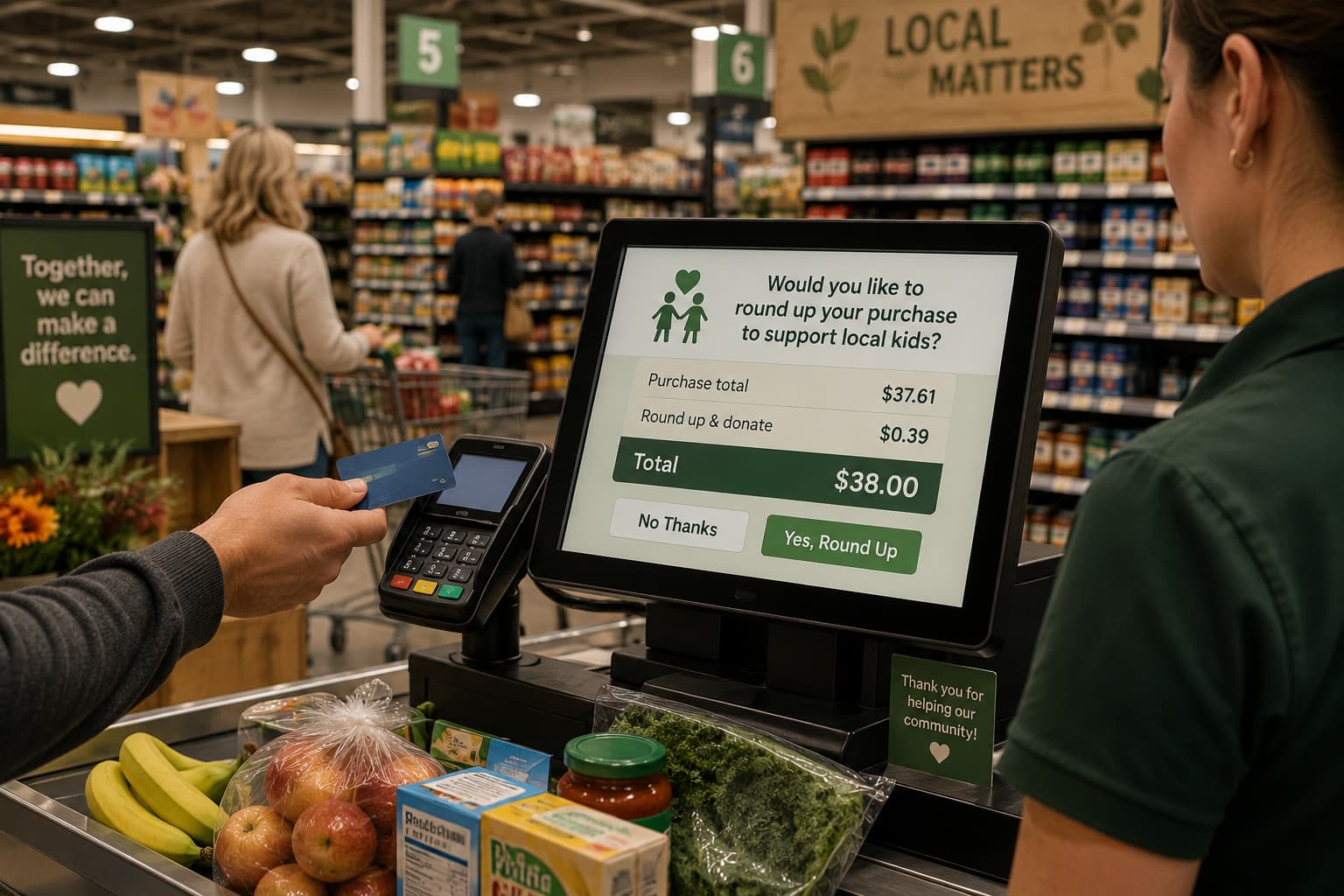
You have almost certainly faced the moment. Your groceries are scanned, your card is in hand, and the cashier or the screen asks whether you would like to round up to the nearest dollar for a good cause, or add a small donation to your total. It takes half a second to decide, the amount is trivial, and yet that tiny prompt is the front line of a fundraising method that quietly moves enormous sums of money every year. Known as checkout charity or point-of-sale fundraising, it is one of the most widespread and least understood forms of giving in modern life, and it rests almost entirely on the psychology of the small ask.
The mechanics are deliberately simple. A customer at a business, most often a grocery store though the practice appears everywhere from pharmacies to liquor stores, is asked to donate a nominal amount, usually by rounding the purchase up to the next whole dollar. Nobody is being asked for a meaningful sum. The whole design depends on the amount feeling too small to refuse and too small to matter. And on its own, a single donation of thirty-nine cents truly does not matter. The power of the method lies entirely in aggregation. Multiply that near-invisible sum across thousands of transactions a day, across thousands of stores, across an entire year, and the cumulative result becomes a genuinely large pool of money raised through the steady accumulation of pocket change.
What makes checkout charity so effective is that it exploits several quirks of human psychology at once, all firing in that brief window at the register. The first is the sheer smallness of the request. Behavioral research has long shown that people evaluate a thirty-cent ask completely differently from a thirty-dollar one, and not in proportion. The small amount slips beneath the threshold at which we do any real calculation. Refusing feels almost absurd, like haggling over nothing, so most people simply say yes to make the moment pass. The second factor is social pressure. The request is not anonymous. A cashier is looking at you, or there is a line behind you, and declining requires a small public act of saying no to a charitable cause in front of witnesses. That friction, mild as it is, nudges a great many people toward agreement.
There is also a genuine emotional reward involved, which is why the practice is not purely manipulative. Saying yes produces a small hit of what researchers connect to the halo effect, the warm sense of having done something good. For the cost of rounding up, the customer buys a flicker of moral satisfaction, and many people value that feeling enough to give willingly and even happily. This is especially true when the cause is clearly connected to the business itself. A pet store raising money for an animal rescue, for instance, meets customers who already care about exactly that cause, and the ask feels natural rather than intrusive. Alignment between the shop and the charity dramatically raises both the rate of giving and the goodwill that comes with it.
But the reactions are far from universally positive, and this is where the honest picture gets more complicated. For every customer who gives with a smile, another feels cornered. The same social pressure that drives donations also breeds resentment. People report feeling anxious or manipulated when put on the spot, and the irritation compounds because the prompts are everywhere. When you are asked to donate at the grocery store, then the pharmacy, then the hardware store, all in a single day, the requests stop feeling like opportunities and start feeling like a tax on ordinary errands. Surveys have captured this fatigue directly. One well-known Canadian poll found that a majority of respondents held a negative view of checkout charity, a striking result for something ostensibly benevolent. When the cause seems unworthy, or simply unexplained, the annoyance sharpens further.
Layered on top of the emotional friction is a persistent question of trust, and here a stubborn myth deserves correction. Many people believe, and the idea spreads readily online, that stores run these campaigns to lower their own taxes, effectively claiming customers’ generosity as a corporate write-off. This is not true, and it is not even possible. Corporate taxes are assessed on profit, and money that customers donate at the register never becomes the store’s profit in the first place. It passes through the business to the charity. The retailer may enjoy reputational benefits and positive associations, which are real motivations, but the tax-dodge story is a misconception. Dispelling it matters, because unfounded cynicism can discourage giving that genuinely reaches good causes.
That said, not all skepticism is misplaced, and there is a serious structural critique worth understanding. Because checkout donations are anonymous and instantaneous, the charity collects the cents but learns nothing about who gave them. It gains no name, no contact, no relationship. Critics point out that this can actually cost charities in the long run, because the deeper value of a donor lies in the ongoing connection, the chance to cultivate someone into a larger, repeat supporter over time. A wall of anonymous micro-gifts raises money today but builds no bridge to the committed donors of tomorrow, and some argue the model trades long-term relationship-building for short-term volume.
For the customer standing at the register, none of this needs to be paralyzing. Checkout charity is neither a scam nor a cure-all. It is a genuinely efficient way to move small money toward real causes, powered by clever psychology that is worth recognizing even as you participate in it. The reasonable posture is simply to give when the cause moves you and to decline without guilt when it does not. The prompt is designed to make no feel hard, but a polite no is always available, and the pennies you round up, small as they seem, really do add up to something on the other end.